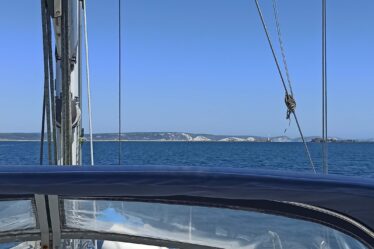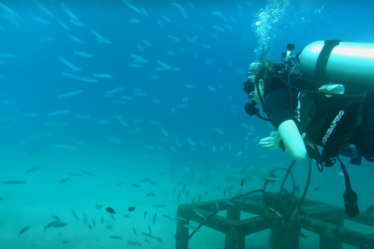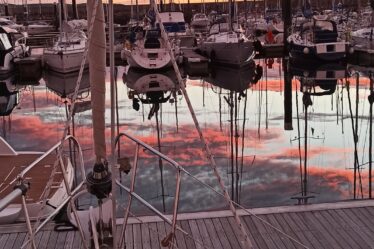
When we first purchased Lanita our cockpit had faced the pontoon. Something that was enjoyable in the first couple of days as neighbouring owners stopped to say hello, but began to feel an inconvenience as we struggled to eat a meal in peace. Coming back in from our first voyage gave us the added benefit of returning to our berth bow first. Our cockpit now surrounded by water, we felt a little extra privacy for day-to-day life.
Two days after that first successful venture into Portland Harbour, we woke to a calm Sunday. Climbing up into the cockpit I admired the nearly smooth surface of water. Clear blue skies allowing the sun to begin warming the day by 7am. We planned to take full advantage of the still morning, and after a quick breakfast, set about preparing.
As it was only the second time in three years that we’d prepared and headed out by boat, there was an electric nervousness in the air – the desire to leave the pontoon safely, somehow creating a desire to leave the pontoon quickly. Despite this, we tried to work through each step methodically. Engine on, navigation instruments on, mooring lines changed so we could slip them from deck. A couple of hours later we were motoring out, the gentle sway of the boat increasing as we left the more protected marina waters.
We made a heading back towards the same anchorage that we’d found on Friday. As with that day, a range of smaller vessels of various sizes and shapes were weaving and gliding their way around the harbour. Luckily for us, and despite their speed, the pilots of those vessels were incredibly adept at avoiding collisions. Portland is the home of the UK’s national sailing academy, so the harbour is not just our playground, but many people’s training ground.
By the time we reached our destination and were ready to anchor, the water was much choppier. This would make anchoring more challenging. I slowed Lanita, turned the bow into the wind, and signalled to Miki at the bow that we were in a position to release the anchor. A whirring clatter filled the air as the metal chain flowed over the side of the boat, reaching my ears despite the winds blowing past. I struggled in vain to keep the bow facing into the wind, but had little steering control due to the lack of propulsion. Veering away did little to help with setting the anchor, and unfortunately, though its weight slowed us, we still moved if I pushed us into reverse. We were dragging.
We discussed what to do, tension in the air as nervous and unsure, we tried to determine the best option. Eventually, we opted to lift the anchor and try again – we couldn’t relax knowing that we weren’t secure.
Without a windlass installed to raise the anchor electronically, Miki began to manually pump a winch to raise the 30m of chain we had dropped to the seabed.
After circling round in the water to reset our position, we had a second attempt. As Miki signalled the anchor had hit the ground I pushed the location pin on our navigation app. We could use this to determine if we strayed further than the metres of chain we had dropped. For the next 15 minutes, we checked and rechecked transits across the water; looked again and again at the map to ensure we hadn’t drifted far from the anchor location pin; and listened for the alarm on our anchor app. We began to relax, more confident that we were set.
As we settled down for the afternoon, Miki went inside to begin making our first-ever hot lunch on our boat, at anchor. It’s incredible how out there, activities that are usually insignificant and even mundane become an adventure. The usual photo view through the galley window was now a moving picture, as slight changes in Lanita’s position shifted what was visible from within.
Now that we were settled, we began to ponder a potential new issue – on motoring to the anchorage that day, we’d noticed a strange noise that seemed to come from the propeller. We thought perhaps something had become wrapped around it. I volunteered to take a dip, emboldened and inspired by the feeling of grand adventure. I would try to see if there was anything obvious that could be the culprit of the sound.
Soon readied for my mission, I stood proudly on deck in a wetsuit, gloves, a wetsuit hat and a rope tied around my waist. GoPro camera in hand. I made my way down the swim ladder, gleeful at the idea of entering the open sea from my own boat. Convinced it was a good idea, until I lowered myself into the biting cold. Breath momentarily taken away with the shock. In an instant, water rushed through every available opening, covering my skin in an icy rush.
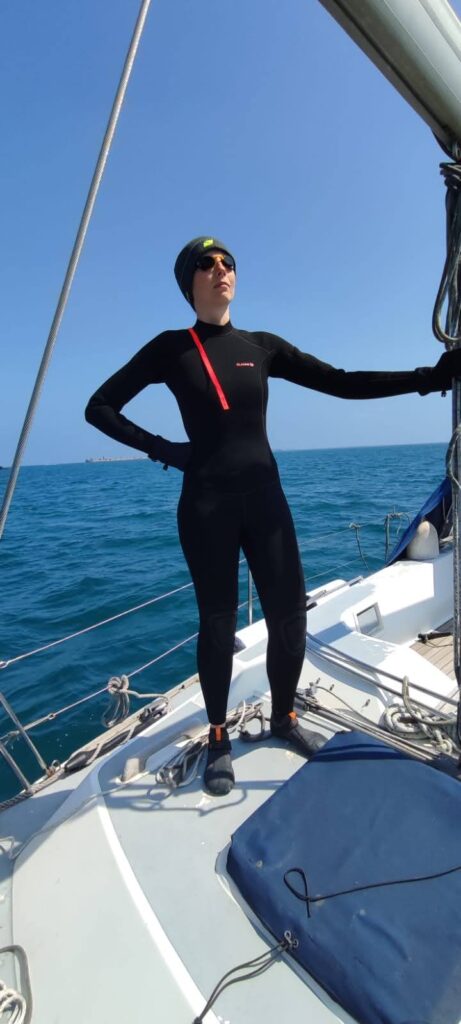
Undeterred and determined (now I was already wet), I took a few moments to acclimatise as best I could, then attempted to duck under to take a look at the propeller. The cold shock I’d felt on climbing down into the water was nothing compared to the icy blast that hit me as I immersed my face, but I persevered. It turned out to be impossible for me to swim forward and down towards the propeller as waves pushed against me. I could keep my head under for mere moments before the water forced me up and back, assisted by the buoyancy of my suit. I accepted defeat after the third or fourth attempt, unable to get anywhere near the propeller shaft, though thankfully I’d managed to catch the odd view through the lens of the GoPro.
As I dried and began to warm in the early afternoon sun, Miki finished preparing lunch. We were soon relaxing in the cockpit, in a moment that felt utterly surreal – lazing in the late spring sunshine, detached from the shore and enjoying the freedom of being alone.
Later that day, back on shore, we began researching potential sources of the sound. Research continued over the following week. Was it inside or outside? Gearbox? Propeller? Engine mounts?… The possibilities seemed endless.
We first tried all investigation options that didn’t involve being lifted out of the water. One evening, using the GoPro on the end of a long metal pole, I lay flat on the pontoon and did my best to aim the lens at the propeller. When watching the footage back, we saw the shaft anode moving as I nudged it. We were by then reasonably certain the anode had come loose and was rattling ferociously every time the propeller was in use.
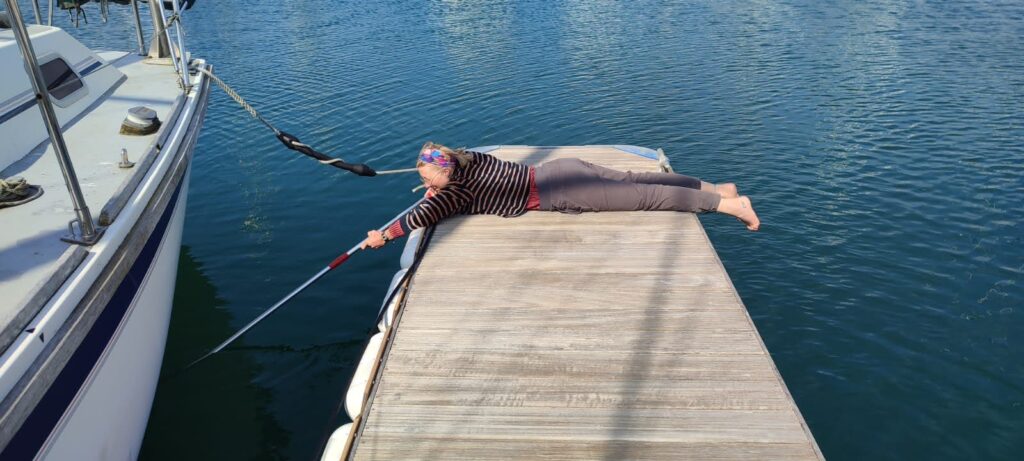
Portland is a very popular spot for scuba divers, so our first thought was to hire someone to go under our boat in the marina to remove the anode – marina regulations say we shouldn’t be in the water ourselves. We would soon learn, however, that recent changes to marina rules meant that (apparently for safety purposes) we would need to hire a team of four divers to complete this small job!
For what seemed a simple process, things were sounding ridiculously complicated and expensive. Either hire a team of four divers or get lifted out of the water, both options cost hundreds of pounds. Then it dawned on us that we had one other option at our disposal. As qualified divers, we could hire gear and do the job ourselves!
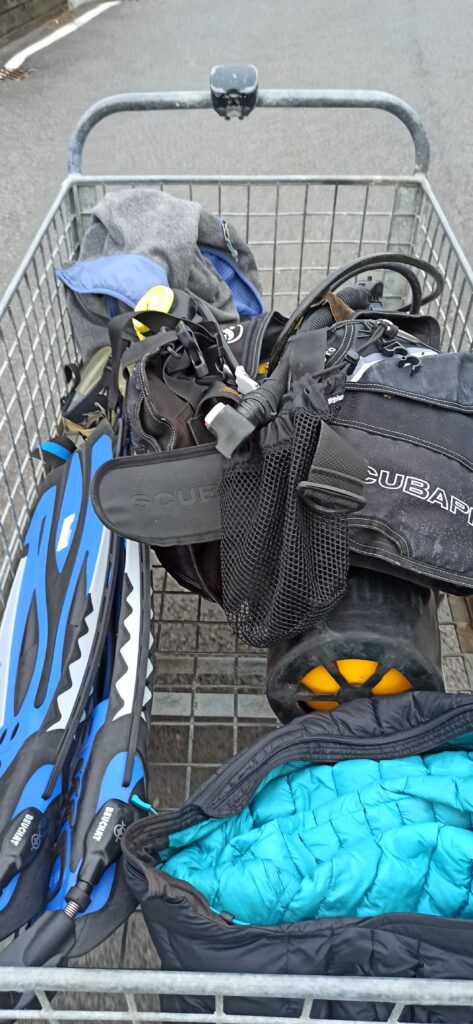
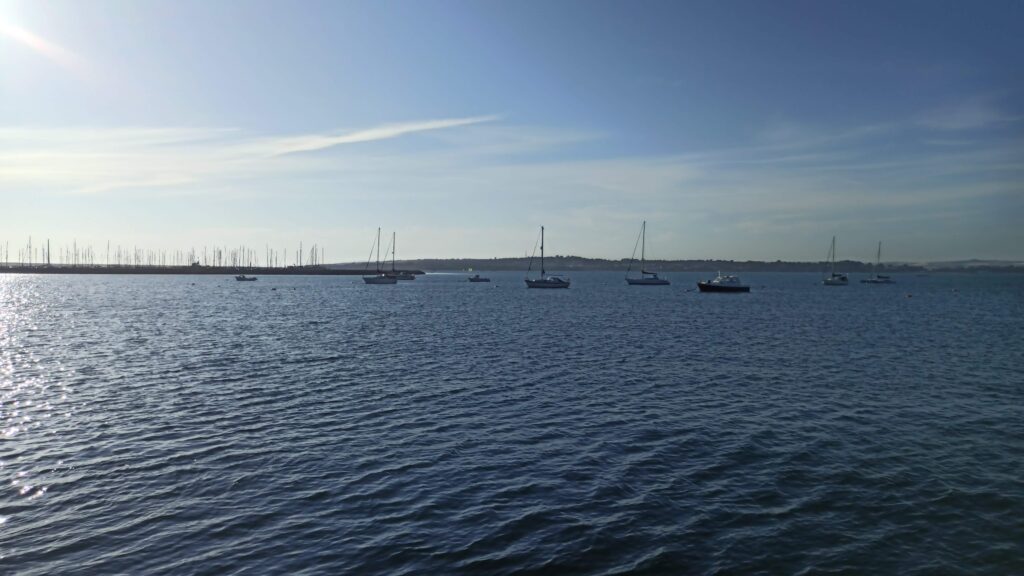
So it was, two weeks after we’d first heard the noise, we started early to prepare for our ‘fix that sound’ mission. Miki was at that moment suffering from a cracked rib, and so we were only hiring scuba gear for me. He was to be on-deck support. As we were, frustratingly, not allowed in the water in the marina, we planned to head just outside of the marina walls to a collection of mooring buoys. We hoped to find a free buoy we could hook up to for an hour or so.
We were in luck. Not only did we have a brilliantly blue sky day and calm waters, but we quickly found a mooring buoy to tether to.
The time to prepare had arrived. I pulled on my wetsuit and wetsuit boots, then carefully prepared my mask by adding a thin layer of soap inside. Once I was ready, I would wash this off, and hopefully benefit from a mask that didn’t fog up. Miki and I then went through the safety checks: checking the main, then the backup regulator; ensuring the BCD (buoyancy control device) inflated and deflated as it should; and making sure the air tank was open. Due to back issues, I shouldn’t hold heavy weight on my back, so I was opting to fasten myself into the BCD once in the water. Miki assisted by passing a rope through a loop on the BCD, which he would pull out after I gave the okay.
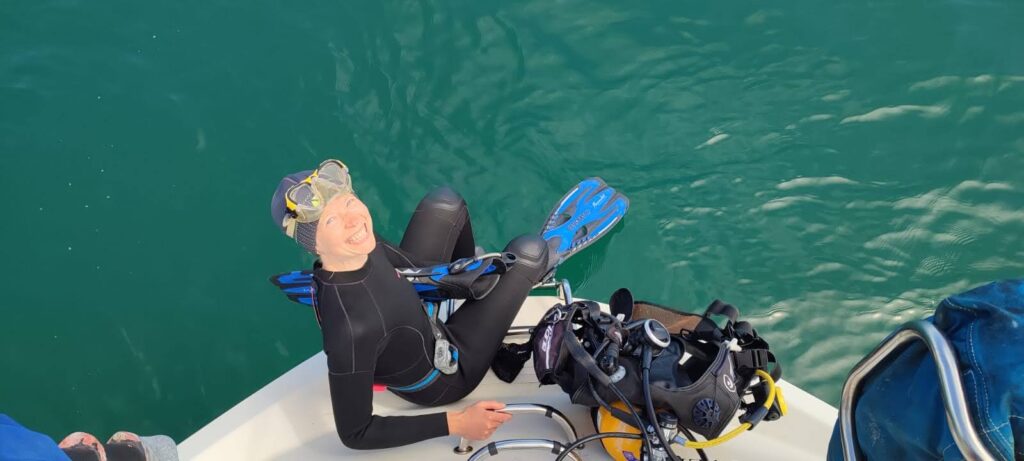
Checks complete, outfit on, mask ready, and fins on. I sat on the back ledge of Lanita and lowered myself into the water. Though it was much calmer than the previous weekend, there was still an icy touch to the salty waves. Having never been scuba diving without a guide or instructor, I felt a mixture of nervousness and excitement. It was an exhilarating feeling to think that I was in complete control of how long I would stay in the water and what I would do whilst there.
After giving Miki the okay and setting loose from the rope, I began my descent. As my gaze lined up with the bottom rungs of the swim ladder, I rotated into a horizontal position and used the fins to glide toward the propeller. I held an Allen key in gloved hands, ready to attempt unscrewing the bolts that held the anode. After a few fumbles, I managed to fit the key in place and begin turning. Momentarily pleased with my success, I soon realised that nothing was loosening. The nut on the back was corroded onto the bolt, meaning they turned in unison.
I made my way back to the swim ladder and up to the surface to request something to hold the nut in place. Miki, waiting on deck and peering over the edge in anticipation, quickly found some pliers for the job.
Returning to my task, I managed (after several failed attempts and a little cursing) to gain a good grip and finally, the bolt began to loosen. I breathed slowly in and out through the mouthpiece, head resting on the underside of the hull, feeling almost as though I were in a scene for an action movie.
It was an incredible feeling – diving below my own boat to fix it. Tools in hand, and relying on my own belief that I could, and would, complete this task. That returning to the marina with the anode still attached wasn’t an option. We spread our tasks fairly evenly on board, but where more strength is required we would generally default to Miki being the lead. Completing this challenging task alone was a boost to my pride and a thrilling experience.
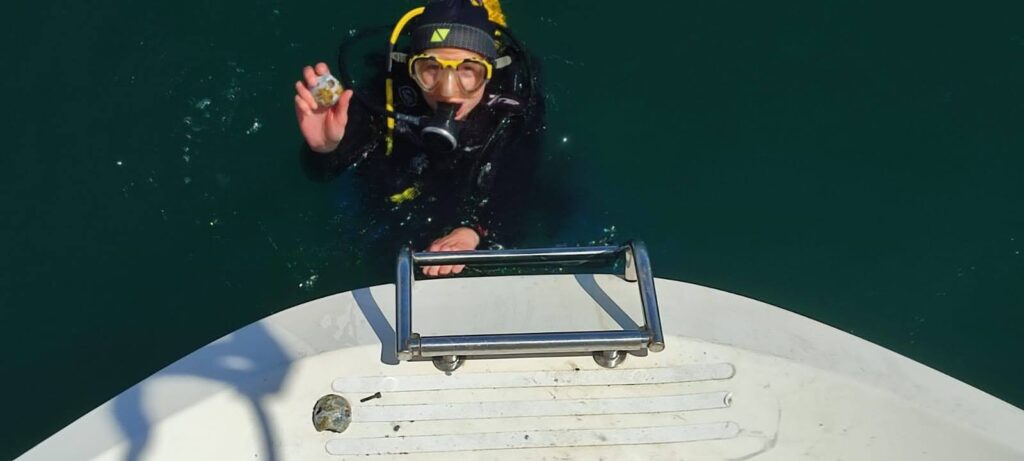
I felt a grin spread across my face as the first nut fell. I caught it in its slow descent and took it with the bolt to the surface, proudly placing them down before looking up at Miki. “This is the perfect tool!” I exclaimed, holding the pliers aloft. Then, replaced the regulator and went below the surface once more.
Numbness began to seep into my head and fingers through constant exposure to the cold as I worked the second bolt free. Determination and steady breathing helped me to remain focused. Mere minutes later, I returned to the swim ladder, bolt, nut, and anode in hand. A wide grin squashed my features up behind the mask I had yet to remove.
Back on board, I removed cold, wet layers as quickly as possible while trying not to indecently expose myself to the dinghy sailors and wing foilers that zipped by. Miki had made lunch, and I enjoyed it behind the protection of the spray hood. Wind was diverted around the structure, while warm, golden sunlight shone through its windows.
While we had lunch, we talked about other ideas for diving in the future and what equipment we may want on board. As we were talking, it dawned on me. This is our life now. It’s not a holiday. It’s not a trip on someone else’s boat. This is our life – a dream turned into reality.