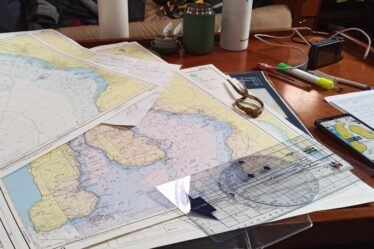
During our first couple of months in Poole, we drove an hour or so east to Portsmouth to meet Mike, a man in his seventies who had replied to my ad on a crewing website. Hoping to learn from this weathered sailor, Miki and I had arranged to crew for a couple of days on a short passage from Portsmouth to Cowes and back.
Mike had suggested we meet him at “Crew Mess”. This turned out to be a quintessentially English cafe where the menu offered everything you could find in an English breakfast and not much else, and the only coffee on offer was instant. We settled into our seats as we took in the small, white-walled room that felt as though it had stood the test of time, remaining unchanged through an era of ever-growing popularity in hipster coffee shops.
With an outspoken, friendly demeanour, Mike spoke to the waitress as though it were far from his first visit. He then did the same when speaking with a lady working in Aldi when we popped in for supplies, leaving me wondering if he always spoke so amicably to everyone he encountered, or whether he knew everyone in the neighbourhood!
This short, sturdy, grey-haired man was friendly but also a little strict. His sometimes military-style of instruction was not a complete surprise coming from this ex-naval officer. He stipulated some rules we’d not come across before, such as having to tell him before taking any photos. This made sense in a way as he wanted to be sure we were always ready to act, though it seemed a little excessive in the very calm conditions we’d be sailing in together. Despite this occasional strictness, Mike made it very clear that questions and curiosity aboard his vessel were very welcome.
Setting sail for Cowes
We arrived at the marina relaxed, Mike gave us a little tour of the clubhouse, and we then made our way down to his 30ft yacht. As we settled in and Mike quizzed me on the tidal information for the day, he realised he’d misremembered the timings by an hour. Suddenly, he sprang into action, placing his navy blue Breton cap upon his head as he gave us instructions to prep his boat to set sail. The tidal stream around Portsmouth is one of the strongest in the UK. Here, the tide often decides where and when you travel, not the wind. We needed to set sail quickly so as to travel with the stream.
The passage to Cowes was mostly uneventful, yet brought with it some elements we hadn’t previously experienced. The first was rain, which, in the context of sailing, takes on a different meaning. It doesn’t just mean getting wet, it means lower visibility and potentially more wind. Rain in the air could also indicate a change in the height and nature of the waves. This wasn’t a downpour, just a sprinkle, but I appreciated the chance to identify the grey clouds drifting low across the water.
Another new experience was being in close proximity to large ships, as our route crossed the major shipping channel leading to the port of Southampton. We’d been taking great pains to avoid entering or leaving Poole Harbour when a ship was expected, fearful of getting too close to the enormous hulls that cut through the water as a knife through cake. After sharing this with Mike, he told us plainly – you won’t avoid them but instead need to keep a constant awareness and plan carefully how to take the waves if they pass close by. As we neared Cowes, a container ship got ever nearer. Miki and I exchanged a glance of concern as we realised Mike planned to play chicken, motoring 90° across the shipping channel, passing (in our view) rather close to the bow of the fast-moving vessel!
After crossing the ship’s path, we then needed to prepare for the water it churned up in its wake. Mike explained the importance of how we took the waves, ideally taking them bow-on. If they were taken on the beam or astern then the size of the waves should be considered. Turning his bow to starboard, we took the waves head-on, bobbing up and down like a toy boat in a bathtub. The largest waves we’d ever experienced hit us in the smallest boat we’d ever sailed on.
Stories from the sea
After heading up the River Medina into the bustling port of Cowes, we moored in one of the many marinas on the west side. Once securely attached to shore, we had a late lunch in what was definitely not the most hygiene-inspired galley. This was immediately followed by Mike offering us both a shot of rum. “Down in one!” he exclaimed as we lifted the glasses. Not being in the habit of drinking with a spritely sailor in his seventies we were caught a little off-guard, but not ones to shy away from a challenge, we did just that! As we began to hear stories of Mike’s time in the navy, and particularly, “tot time”, being instructed to down our shots became less of a surprise.
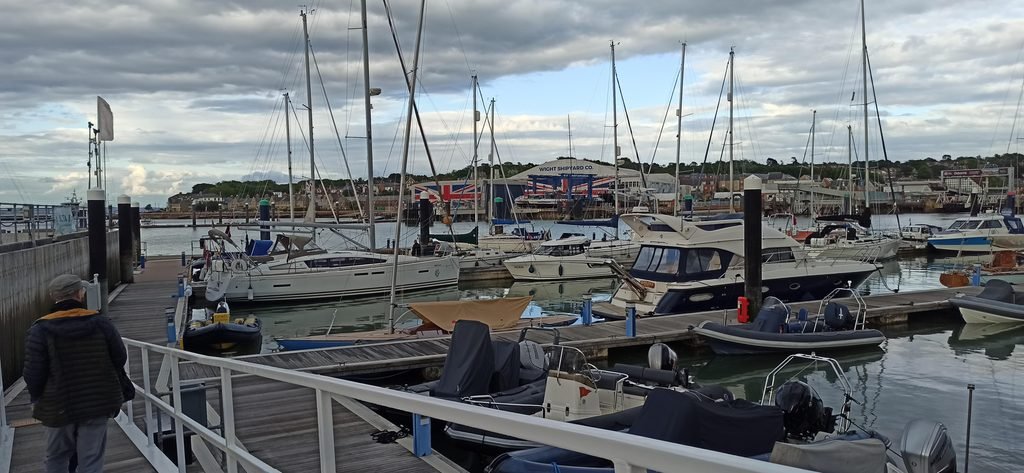
Mike had been in the navy for a number of years, during an era where a shot of rum was allocated to each man on ship every day. The dispensing of the rum was known as “tot time”. It was a time where rum was considered a currency. A man may want another to cover his shift so he could take a woman out to dinner, and could pay his “tot” for the day to the man doing him this favour.
Following our impromptu early afternoon tipple, we wandered into the small town of Cowes – the sailing capital of the UK. We walked along the quiet high street where each shop window framed a picture of the sailing world. High-end sailing clothes tempted us from behind several panes of glass, while others revealed galleries displaying paintings of sailing events.
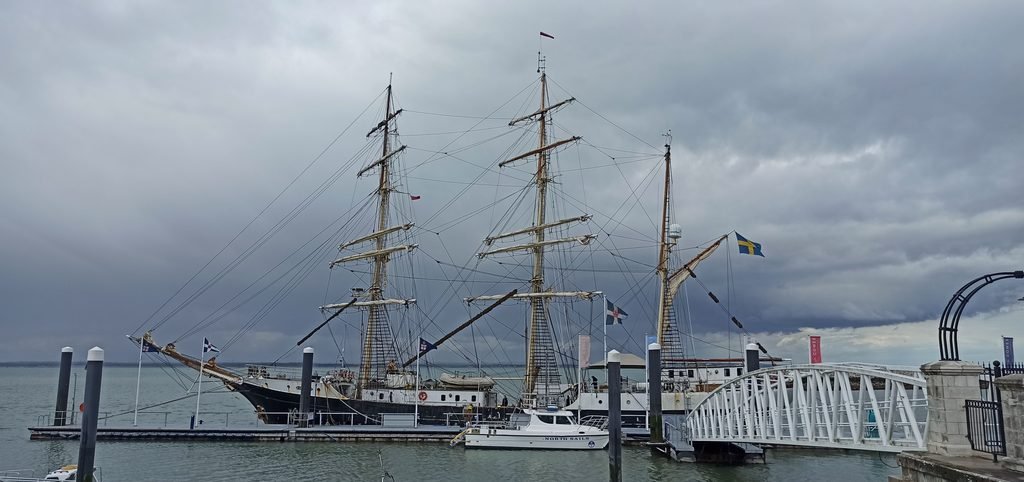
It took mere minutes to walk from one side of the centre to the other. We were soon past the red brick buildings and were heading along a raised path following the coastline, giving us a clear view to the mouth of the river we’d entered an hour or so before. Attached to the dock was the Swedish training ship “Gunilla”. Ant-like humans busied themselves on board the majestic, nearly 45-metre, three-masted vessel.
A little further along, we passed a protective breakwater, and within the enclosed area a ramp led down to a handful of pontoons. This was The Royal Yacht Squadron, the only yacht club with a royal decree, and the right to fly a variant of the naval white ensign – something much disdained by Mike. A sailing crew arrived to moor as we stood watching, lacking both confidence and precision in their manoeuvring, and doing nothing to improve Mike’s opinion on the matter!
Finally, we reached a semicircle of cannons facing seaward with a large flag pole standing proud and central. A viewing box was situated a little higher up the hill on our left. This was, Mike told us, the start and finish line of the famous Round the Island sailing race that happens each summer.
Satisfied that he’d shown us the town’s most significant sailing landmarks, Mike took us back into the centre to his favourite pub (not without pausing to converse with a woman about the chips she was eating and to pet her dog). We settled around a large, circular table which was nestled in a quiet nook in the back corner of the bustling pub. Across our pints, Mike regaled us with many more stories from his time on the water: the occasion his wife had ended up overboard when they came in to moor at a pontoon, luckily popping up the other side of the pontoon from their incoming vessel; the fisherman who’d been sinking as he sped towards the shore for safety; their dog, who’d jumped into the water with a strong tidal current – Mike had grabbed hold of his harness and eventually managed to pull all 25kg of him back on board. Then there was the time someone had stolen a commercial vessel from the Isle of Wight… By then, Mike was part of the Met Police and was tasked with capturing the drunken, renegade employee. Realising he was eventually going to be caught, the employee had joy-ridden through the waves until he ran out of fuel.
There were other stories, more than I can remember, and too many to fill this post with! After an adventurous working life, Mike now relished the chance to meet new people through sailing to share some of those treasured tales. He generously shared his knowledge of the water in exchange for the company of those also looking for new adventures at sea.
After our second pint we made our way back to the boat where Miki and I prepared some dinner while Mike enjoyed fish and chips from a shop which hadn’t had any vegan options. As we ate, Mike pulled out some CDs and pushed one into the onboard player. Sounds of Motown danced through the air, soon followed by Queen’s greatest hits, the music interrupted every now and then by the ship’s radio. Mike blissfully swayed and sang along, only momentarily distracted as he shooed a seagull from the cockpit.
As darkness fell, Miki and I each laid our sleeping bags on a sofa on either side of the saloon, Mike tucked away in a quarter berth aft cabin. We’d chosen the saloon over the forepeak to keep as far away from the mould we’d noticed around the place as possible. Even so, we both lay in slight discomfort, noses straining toward the open companionway for fresher air. We’ve noticed a pattern among weekend boaters who seem to prioritise sailability above all else. Though this makes sense to an extent, we’re always a little taken aback that hygiene and clean air (and thus, health) has such a low priority.
Back to the mainland
Due to a wind-free return passage the next morning, Mike spent time pointing out old naval structures while the tidal stream carried us back towards Portsmouth. One of these was the Submarine Escape Training Tank, where trainees practised ascending a water-filled tower from bottom to top. If they failed to breathe out, they could expect a punch to the stomach! Exhaling was crucial to avoid damaging their lungs while rising rapidly through the water, simulating emergency exits from submerged submarines.
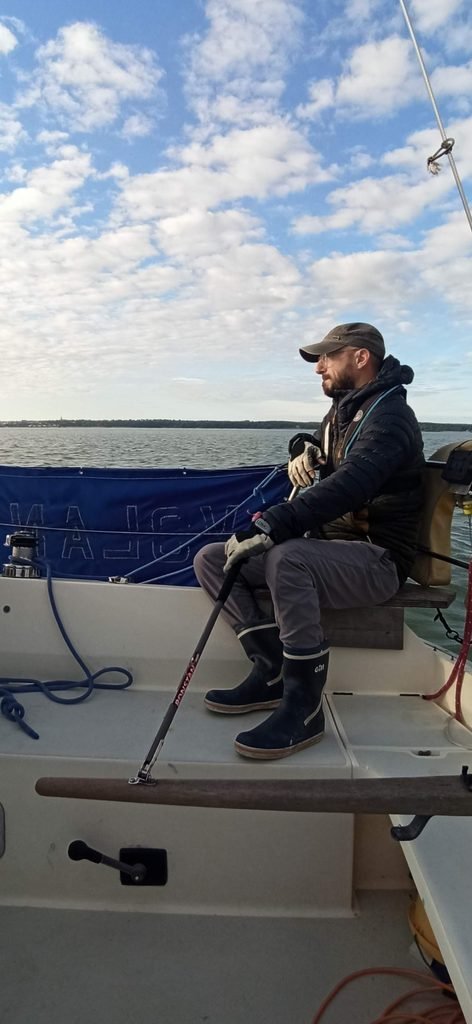
As we neared the entrance to Portsmouth Harbour, with Miki at the tiller, we were suddenly faced with a ship exiting, and three speed boats taking up the majority of the small boat channel beside it. Panic barely began to bristle within before Mike stepped into gear, directing Miki where to aim so that we moved through with ease. Caught in the wash created by both the ship and motorboats, our little vessel bobbed around excitedly, but under Mike’s steady instruction, we never lost control. He impressed upon us the importance of knowing when to switch between relaxation and assertion in a split second. This moment turned out to be a great cure for our fear of big ships and traffic – if you’re unsure about something, it turns out a huge dose of that very thing is often the cure (like the time I accidentally put too much ginger juice in my tea…).
Though we’d embarked on this mini adventure with Mike to further extend our sailing, I left with a joy more closely related to the experiences we’d had in the company of this old sea dog. In what other “sport”, I mused, do you meet other people, stay with them straight away, and it gets that real that quickly?! Perhaps this was a one-off, though I truly hope it was not. Sharing random stories of life with near strangers is an element of the backpacking world that I’ve missed – a lifestyle where you are so quickly immersed in stories of other people’s lives. Though there were honestly so many stories that Miki and I were a little exhausted by the end, this quirky adventure is without doubt an experience I’ll treasure.